

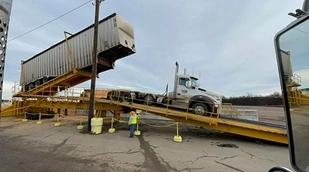
Transporting oversized cargo across Oregon is never as simple as loading a truck and hitting the road. Between ODOT permitting windows, pilot car requirements, and weight-sensitive corridors on I-5 and Highway 20, a single misstep can mean costly delays, fines, or worse — a shutdown in the field. After more than 57 years of heavy haul operations out of Springfield, we've learned every nuance of the system. Here's what shippers need to know right now.
What Qualifies as an "Oversize Load" in Oregon?
Oregon defines an oversize load as any vehicle or load exceeding standard legal dimensions: 8 feet 6 inches in width, 14 feet in height, 53 feet in length (for a single vehicle), or 105,500 lbs gross vehicle weight. Once any one of these thresholds is crossed, you're in permit territory — and the requirements ramp up quickly depending on how far beyond the limit you go.
Width is by far the most common trigger we see in our heavy machinery hauls. Construction equipment, industrial tanks, and prefab modules routinely push past the 8'6" mark. A load that's 12 feet wide will require not just an oversize permit but also a detailed route survey, specific travel time windows, and in most cases, pilot car escorts front and rear.
- Width over 8'6" — Oversize permit required; escort cars needed over 14'
- Height over 14' — Permit required; bridge and utility clearance survey needed
- Length over 75' (combination) — Special routing and travel time restrictions apply
- Weight over 105,500 lbs GVW — Permit required; bridge ratings must be verified
- Any dimension exceeding 16' wide or 150' long — Requires ODOT special movement permit
The ODOT Permit Process: What to Expect
Oregon's oversize/overweight permits are administered through the ODOT Permit Office, and the process can range from a same-day online transaction to a multi-week review depending on the complexity of your move. Single-trip permits for routine oversize loads are typically issued within 24 hours through the Oregon Trucking Online portal. But loads that exceed what ODOT calls "superload" thresholds — generally anything over 200,000 lbs or 16 feet wide — require a full engineering analysis and can take two to four weeks.
"We've seen shippers lose weeks of project time because they underestimated the permit lead time on a complex move. Get us involved early — before the equipment even leaves the manufacturer — and we can often compress that timeline significantly." — Operations Team, Morris O. Nelson & Sons, Inc.
One detail that catches first-time heavy haul shippers off guard: ODOT's permits are route-specific. You can't simply obtain a permit and choose your own path. The permit office will approve a specific route, and deviating from it — even due to a road closure or construction — requires a permit amendment. Our team maintains current knowledge of approved corridors and common route restrictions across the state, which saves clients from last-minute scrambles.

Pilot Cars and Escort Requirements
Pilot car (escort vehicle) requirements in Oregon scale with the size of the load. A load between 10 and 14 feet wide typically requires one front escort. Beyond 14 feet, rear escort is added. At certain dimensions and in certain corridors, law enforcement escorts become mandatory — these must be arranged directly with the county sheriff or Oregon State Police and can add to both cost and scheduling complexity.
Pilot car drivers in Oregon must be certified and carry proper equipment: height poles, two-way radios, oversize load signs, and amber lights meeting ODOT specifications. Using uncertified escorts is a common audit target and can invalidate your permit entirely.
Travel Time Windows and Seasonal Restrictions
Oregon restricts oversize movements to daylight hours on most routes, with many corridors also prohibiting travel on weekends, holidays, and during peak traffic periods. Some mountain passes — including portions of US-20 over the Cascades and OR-58 through Willamette Pass — have seasonal weight restrictions that tighten significantly between November and April.
Spring road bans are a particular concern for heavy haul. Oregon's freeze-thaw cycle causes significant pavement stress, and ODOT responds with seasonal weight restrictions that can reduce legal axle weights by 25–30% on affected roads. Planning a large machinery move in March or April without accounting for spring restrictions can mean either a delay until bans are lifted or a complex re-route through unaffected corridors.
Key Seasonal Considerations
Winter weather adds another layer. Chain requirements on mountain routes are non-negotiable and are actively enforced by ODOT. Our drivers are equipped and trained for chain-up operations, and our dispatch team monitors conditions in real time — but shippers should build weather buffer into any timeline for moves crossing the Cascades between October and May.
Working with an Experienced Oregon Heavy Haul Carrier
The difference between a smooth heavy haul move and a regulatory nightmare often comes down to the carrier you choose. An experienced Oregon-based carrier brings pre-existing relationships with the ODOT permit office, a mapped knowledge of approved routes and bridge ratings, and field experience navigating the kind of surprises — soft shoulders, low utility lines, permit amendments — that derail less seasoned operations.
At Morris O. Nelson & Sons, we've been moving oversized and overweight freight across Oregon since 1967. Our team handles the full permitting process, provides certified pilot car services, and coordinates law enforcement escorts when required. If you have an upcoming heavy haul move anywhere in Oregon, contact our operations team early — the more lead time we have, the more options we can put on the table.